Know What Your Market Buys. Know What Your Factory Can Build.
Command reads your sales, your market, your competitors, and your factory — then tells you exactly what to order next.
Every model.Every trim.Every package.Every option.Every color.Every factory constraint.
4
Data sources
Every
Factory code
AI
Order recommendations
Factory constraint
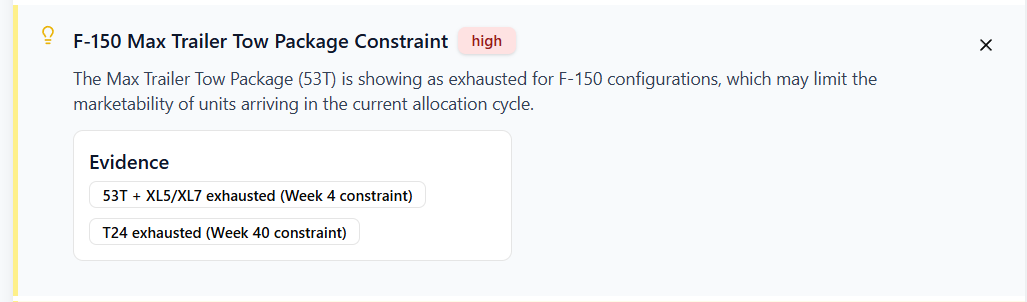
53T Max Trailer Tow exhausted
Week 4 constraint · reroute F-150 orders
W3L · 302A · 998 · 44G · 193 · DR · 53T · XL5 · XL7 · T24 · U4X · X2C · X9Y
Three Intelligence Layers. One Optimized Ordering Strategy.
Layer 1 · Your Dealership's Actual Sales
Every Vehicle You've Sold Tells a Story. AI Reads Every Detail.
InventoryPilot Command deeply analyzes historical DMS sold-vehicle records, decoding exact factory configurations. The AI identifies which exact builds have historically performed best at your dealership — not simply which models sold the most.
- Model and trim
- Engine and drivetrain
- Factory equipment groups
- Package codes
- Individual option codes
- Exterior paint codes
- Interior trim and color codes
- Cab and bed configurations
- Equipment combinations
- Historical sales velocity
- Days to sell
- Configuration-level demand patterns
Layer 2 · Your Entire Local Market
Your Best Inventory Opportunities May Be Vehicles You've Never Stocked.
InventoryPilot Command analyzes historical vehicle sales across your defined local competitive market — independently of your own sales — including detailed factory configurations. It then reconciles that historical demand against current competitive inventory.
Historical Market Sales
Identify which models, trims, equipment packages, individual factory options, and exterior/interior color combinations have actually sold across the market.
Market Configuration Demand
Understand historical customer purchasing preferences beyond the dealership's own sales history.
Current Competitive Inventory
Analyze vehicles currently advertised and available across the local market, including their specific build configurations.
Demand vs. Available Supply
Compare historical market sales patterns against current inventory availability to identify potential undersupplied and oversupplied configurations.
Market Opportunity Identification
Find high-demand configurations with limited current competitive availability.
Untapped Inventory Opportunities
Identify vehicle builds that perform well across the market but are missing or underrepresented in the dealership's own inventory.
Competitive Configuration Gaps
Discover package, option, drivetrain, and color combinations with meaningful historical demand and comparatively limited market supply.
Market-Aligned Factory Ordering
Recommend builds based on demonstrated local demand, current competitive supply, and the dealership's inventory position.
Market Velocity Intelligence
Evaluate historical sales movement and current availability at the most detailed configuration level supported by the data.
Continuously Updated Market Supply
Use current inventory observations and available data refreshes to update market opportunity analysis. Observed inventory is clearly distinguished from verified real-time availability.
Your dealership's sales history tells you what you've sold. The market tells you what you could be selling.
Layer 3 · OEM Supply Chain & Factory Buildability
A Perfect Inventory Opportunity Means Nothing If the Factory Can't Build It.
InventoryPilot Command evaluates manufacturer production realities before generating ordering recommendations. The AI reconciles market demand opportunities against manufacturer production and allocation constraints to identify viable orders — market-demand intelligence that is aware of real-world OEM supply limitations, not an ordering spreadsheet with AI added.
- OEM commodity constraints
- Factory production restrictions
- Equipment and component shortages
- Allocation quantities and eligibility
- Production scheduling windows
- Order-bank availability
- Model-year transitions
- Factory package dependencies
- Option compatibility and buildability
- Production capacity and availability
- Restricted powertrains and configurations
- Available alternative configurations
- Existing orders and incoming inventory
- Supply chain disruptions reflected in available OEM data
Find the Vehicles Your Market Wants Before Everyone Else Stocks Them.
The Market Opportunity Engine evaluates combinations of these signals to identify opportunities:
- 1Dealership historical sold configurations
- 2Market-wide historical sold configurations
- 3Current dealership inventory
- 4Current competitive market inventory
- 5Historical market sales velocity
- 6Configuration-level demand patterns
- 7Incoming inventory and existing factory orders
- 8OEM allocation and production constraints
Illustrative example: a particular F-150 trim, equipment group, engine, and exterior color combination has historically sold well across the market. Current competing inventory contains relatively few matching configurations. The dealership has limited or no representation of that build. The OEM has an available allocation and the configuration is buildable under current constraints.
InventoryPilot Command identifies that alignment as a potential factory ordering opportunity.
Opportunity card
Illustrative- Vehicle
- 2026 F-150 XLT SuperCrew 4x4 5.5' (W3L)
- Build
- 302A Mid · 998 3.5L EcoBoost · 44G 10-speed · 193 Black Appearance · Avalanche (DR)
- Market demand
- Strong historical configuration demand
- Competitive supply
- Limited matching inventory
- Dealership stock
- Underrepresented
- OEM buildability
- Eligible under supplied constraints
- AI recommendation
- Prioritize this configuration for available allocation
Market sold data behind it
Last 90 days · retail sales within 50 miles · this exact build vs. all F-150 XLT
| Metric | This build | All XLT |
|---|---|---|
| Units retailed (90 days) | 42 | 310 |
| Avg. days to turn | 21 | 47 |
| Competitor units in stock | 9 | 485 |
| Market days' supply | 19 | 141 |
| Your stock + in transit | 0 | 38 |
Why this was recommended
- • Demand: 42 retailed in 90 days, turning in 21 days vs. 47 for XLT overall
- • Supply: only 19 days' supply on competitor lots vs. 141 for XLT overall
- • Dealership: zero units in stock or in transit
- • OEM: allocation available; no supplied constraint blocks the build
Not Just Which Truck Sold. Exactly Which Truck Sold.
Traditional reports frequently stop at model and trim. InventoryPilot Command analyzes the detailed factory build — revealing demand for combinations that broad model-level reports overlook.
Traditional Report
Ford F-150 XLT — Units Sold
InventoryPilot Command
2026 F-150 XLT W3L · 302A · 998 3.5L EcoBoost · 44G · 193 · Avalanche (DR)
- Exact engine and drivetrain
- Factory equipment group
- Individual package codes
- Factory option codes
- Exterior paint code
- Interior trim code
- Historical dealership sales performance
- Historical market sales performance
- Current market configuration availability
- Dealer inventory coverage
- OEM production constraint status
- AI ordering recommendation
From Market Opportunity to Factory Order Recommendation.
InventoryPilot Command combines dealership demand, market-wide demand, competitive inventory availability, incoming supply, and OEM buildability into an intelligent factory ordering strategy that weighs both demand opportunities and manufacturer production realities. It recommends:
- Which models to prioritize
- Which trims to order
- Recommended quantities
- Factory equipment groups
- Individual packages and options
- Exterior and interior colors
- Engine and drivetrain combinations
- Alternative builds when constrained
- Allocation priorities
- Future inventory mix
See It Inside InventoryPilot Command.
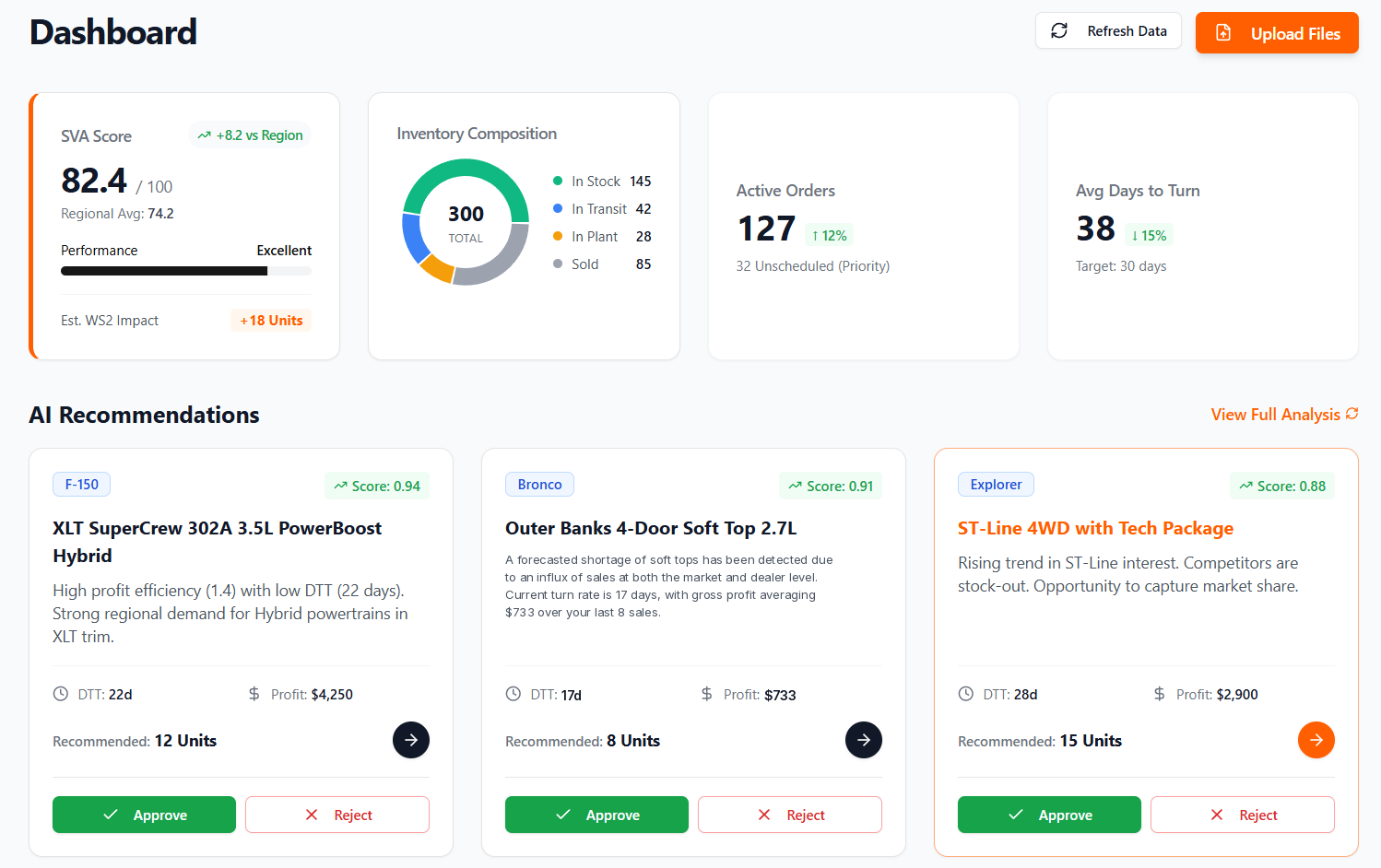
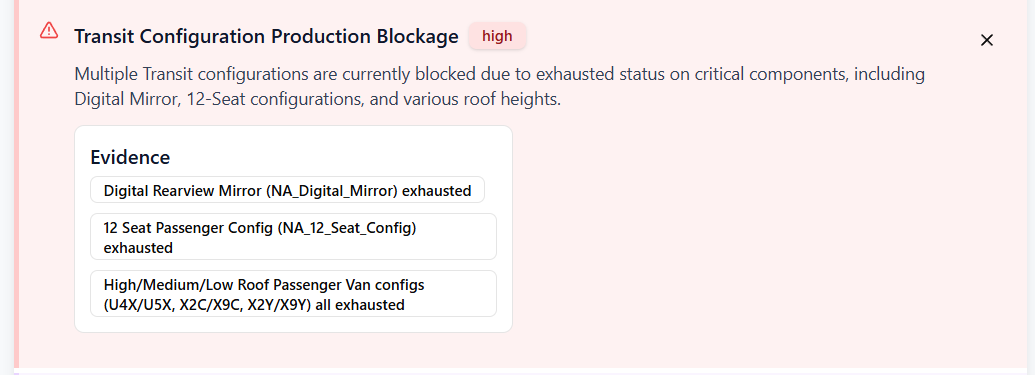
Screens from the application: scored order recommendations you approve or reject, and OEM buildability alerts with the evidence behind them.
Six Core Capabilities
Deep DMS Sales Intelligence
AI analysis of the dealership's historical sold configurations down to factory package, option, and color codes.
Market-Wide Sales Intelligence
Historical sales analysis across the local market to reveal demand beyond the dealership's own sales.
Competitive Inventory Intelligence
Current market inventory configuration analysis to identify competitive supply gaps.
OEM Supply Chain Awareness
Manufacturer constraints, allocation availability, production scheduling, and buildability intelligence.
AI Configuration Optimization
Factory build recommendations aligned with dealer demand, market opportunity, and OEM constraints.
Predictive Inventory Planning
Forward-looking inventory recommendations considering current stock, incoming vehicles, historical sales, and expected demand.
Stop Ordering Based on What You Think Will Sell.
Traditional Ordering
- Historical dealership sales reports
- Broad model and trim analysis
- Manual factory option selection
- Limited competitive inventory visibility
- Separate manufacturer allocation reports
- Reactive adjustments to OEM constraints
- Spreadsheet-based ordering decisions
InventoryPilot Command
- Deep DMS sold-configuration analysis
- Historical market-wide configuration demand
- Current competitive inventory analysis
- AI detection of undersupplied configurations
- Package, option, and color-code intelligence
- OEM supply chain constraint awareness
- Factory buildability optimization
- Market-aligned ordering recommendations
- Explainable AI decision support
Three Sources of Intelligence. One Smarter Inventory Strategy.
- 1
Learn Your Dealership
Analyze actual DMS sales and existing inventory at the factory-configuration level.
- 2
Understand Your Market
Analyze historical local-market sales and current competitive inventory to identify demand and supply gaps.
- 3
Evaluate the Factory
Reconcile opportunities with OEM allocations, commodity constraints, scheduling windows, and build rules.
- 4
Recommend the Right Builds
Generate configuration-level factory ordering recommendations aligned with dealership performance, market opportunity, and production feasibility.
Recommendations are explainable decision support — your team makes the final ordering call.
Order for the Demand That Exists. Not Just the Demand You've Experienced.
- Discover previously overlooked market demand
- Identify high-demand, low-supply vehicle configurations
- Improve model, package, option, and color selection
- Reduce reliance on manual inventory analysis
- Make better use of available factory allocations
- Avoid recommending builds affected by known OEM restrictions
- Improve future inventory alignment with market demand
- Identify gaps in the dealership's existing inventory mix
- Support faster, more informed ordering decisions
- Improve inventory planning consistency across dealership groups
Potential benefits. Results depend on your market, manufacturer, data availability, and team decisions.
Your Dealership Knows What It Sold. InventoryPilot Command Knows What Your Market Wants Next.
Discover how dealership DMS intelligence, market-wide historical sales, current competitive inventory, and OEM production awareness work together to optimize your next factory ordering decisions.
InventoryPilot Command understands what your dealership has sold, what your entire market has historically purchased, what competing dealers currently have available, and what the manufacturer can actually build — and brings all four together to recommend the right vehicles, configurations, and factory orders.
Want your current inventory easier to find online? See our AI vehicle descriptions or the dealer guides.